
Bi-manual Robot Learning
Many everyday tasks require two arms, yet programming robots to work together remains time-consuming and often produces solutions tied to a single task. This project aims to make dual-arm robot programming faster and more adaptable by extending our skill-based approach in SkiROS2. We combine reusable, semantically described robot skills with a shared world model, task planning and behaviour trees that organise and execute robot actions.
We investigate coordination at two levels: scheduling the arms’ actions so that independent skills can run in parallel, and developing skills with continuously synchronised motion when both arms must act together. Learning from demonstrations and reinforcement learning will help select and adapt skill parameters, while explicit knowledge about objects, task conditions and the robot’s state supports interpretable task control. The aim is to balance objectives such as safety, speed and reliability while retaining the modularity of individual skills.
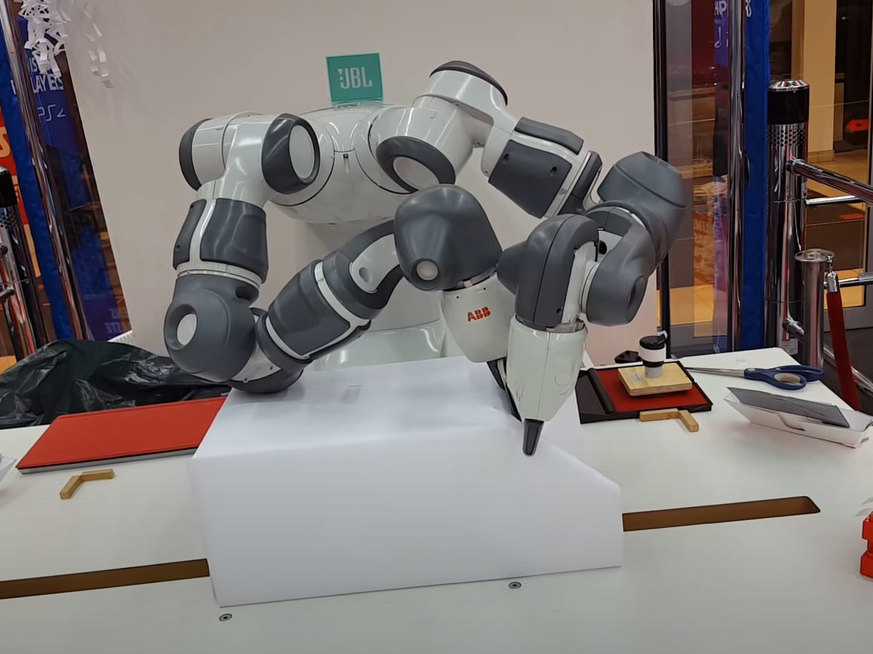
A central demonstrator revisits our 2015 ABB YuMi gift-wrapping application, which required two person-months to program. We aim to recreate it in less than 10% of the original programming time and reuse the same skills in other tasks and robot platforms. Further demonstrations will address handling boxes of dishes, inspired by the WARA Robotics Challenge, and transfer to a dual-arm KUKA setup.
We will evaluate task success, programming effort, the speed of learning skill parameters and execution efficiency. These experiments will test how well the approach supports reusable, adaptable dual-arm behaviour in physical robot systems.
Last updated: 2026-11-10